
When the Year Ends and Grief Speaks

Listening to what rises between reflection and moving forward
by: Dr. Tammy Isaac

As a year comes to an end, grief often finds its voice. Not because something new has happened, but because endings create space for remembering. When the pace slows and the calendar thins out, what has been carried quietly all year begins to surface. Grief speaks in this space not to demand answers, but to be acknowledged.
This moment between years is not about closing chapters neatly or rushing toward what comes next. It is about listening. About honoring what was lived, what was lost, and what had to change along the way. When the year ends, grief speaks. And how we listen matters.
Grief Shows Up at the End of a Year
Grief often rises during transitions. Endings remind us of people who are no longer here, plans that shifted, and versions of ourselves that had to change in order to survive. Reflection brings contrast between what we hoped for and what actually unfolded.
Sometimes grief shows up as sadness. Sometimes as exhaustion, restlessness, or numbness. Sometimes it shows up quietly, as a heaviness we cannot quite explain. This does not mean something is wrong. It means the heart finally has space to respond to what it has been carrying. Grief does not only come from death. It can come from loss of identity, health, relationships, expectations, or direction. When a year ends, all of these losses can surface at once.
Grief as a Keeper of Time
Grief keeps time differently than calendars do. It measures life in before and after. In moments that reshaped us. In distances traveled internally, even when nothing obvious changed on the outside.
Time can feel uneven in grief. Some days stretch long and heavy. Others move quickly but leave us unsettled. Certain dates, seasons, or ordinary moments suddenly carry weight.
This does not mean you are stuck. It means grief remembers what mattered. Surviving this year counts. Even if the journey was quiet. Even if it was exhausting. Even if no one else saw the strength it required. Grief holds the record of what you endured and how you adapted.
Giving Yourself Permission to Acknowledge the Year
There is often pressure to summarize a year neatly. To decide whether it was good or bad, productive or disappointing. But grief does not fit into clean summaries. Acknowledging the year means releasing the need to make sense of everything right now. It means allowing the year to be layered, unfinished, and complex if that is what it was.
Grief changes capacity. What you were able to do this year may look different than before. Rest, reflection, and simply continuing were not failures. They were necessary responses to what you lived through. Nothing you felt was wasted. Every tear, pause, and moment of uncertainty mattered.
Hope Without Pressure
Hope is often misunderstood in grief. It is not something you are required to feel, and it is not a sign that you are “doing better.”
Hope, when it is honest, arrives quietly. It shows up in breath. In endurance. In presence. In the realization that life continues to unfold, even while grief remains.
Hope does not replace grief. It walks alongside it. You can miss what was and still make room for what may come. These truths do not cancel each other.
Setting Expectations That Honor Grief
As a new year begins, instead of focusing on resolutions, consider expectations that honor your humanity. January does not erase December. A new year does not cancel grief. Setting expectations that honor grief means allowing yourself to move forward without leaving parts of yourself behind. It means recognizing that grief and hope can coexist. That memory and movement can share space. You are not required to rush healing. You are not behind. You are moving at the pace your life requires.
Moving Forward
When the year ends and grief speaks, listening is an act of care. You can hold on to what you loved, honor what you lost, and still make room for what is ahead. You do not need to carry everything perfectly. You only need to move honestly. One breath at a time is enough.

This blog coincides with the Season Four opening episode of the Permission to Breathe Podcast, available January 5th on Spotify and Apple Podcasts.
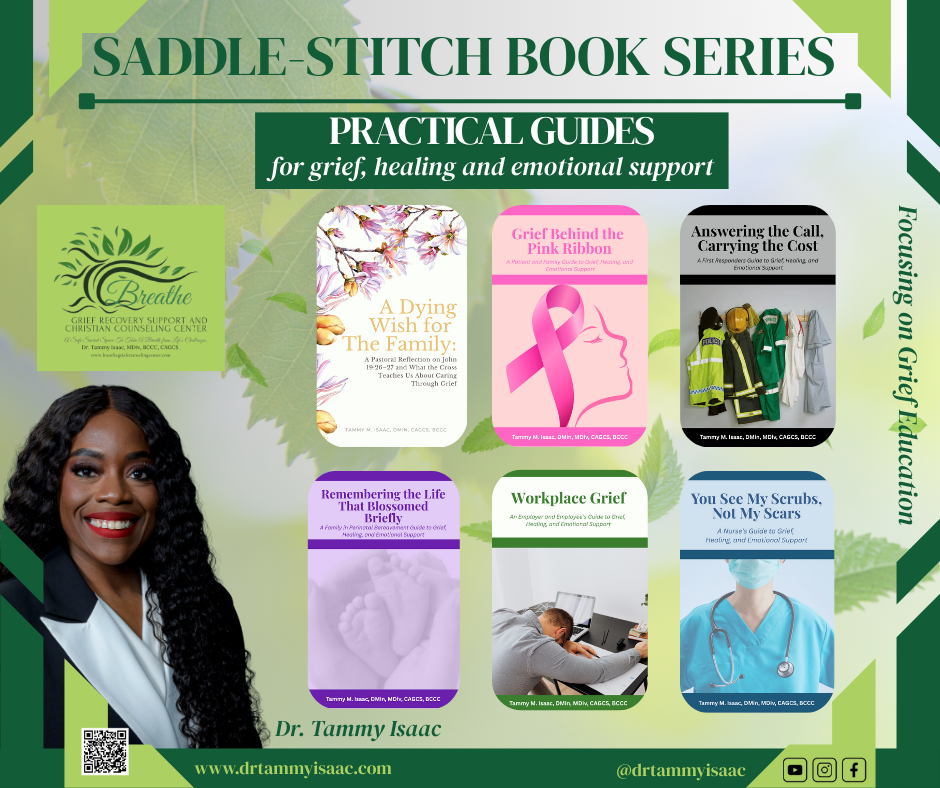
I’m grateful to share the release of my new saddle stitch book series focused on grief, emotional support, and healing. This series was created to be accessible, honest, and practical. Each booklet is designed to meet people where they are by offering language for what hurts, guidance for what feels confusing, and space to breathe through loss without pressure to rush or fix anything.


Comments